

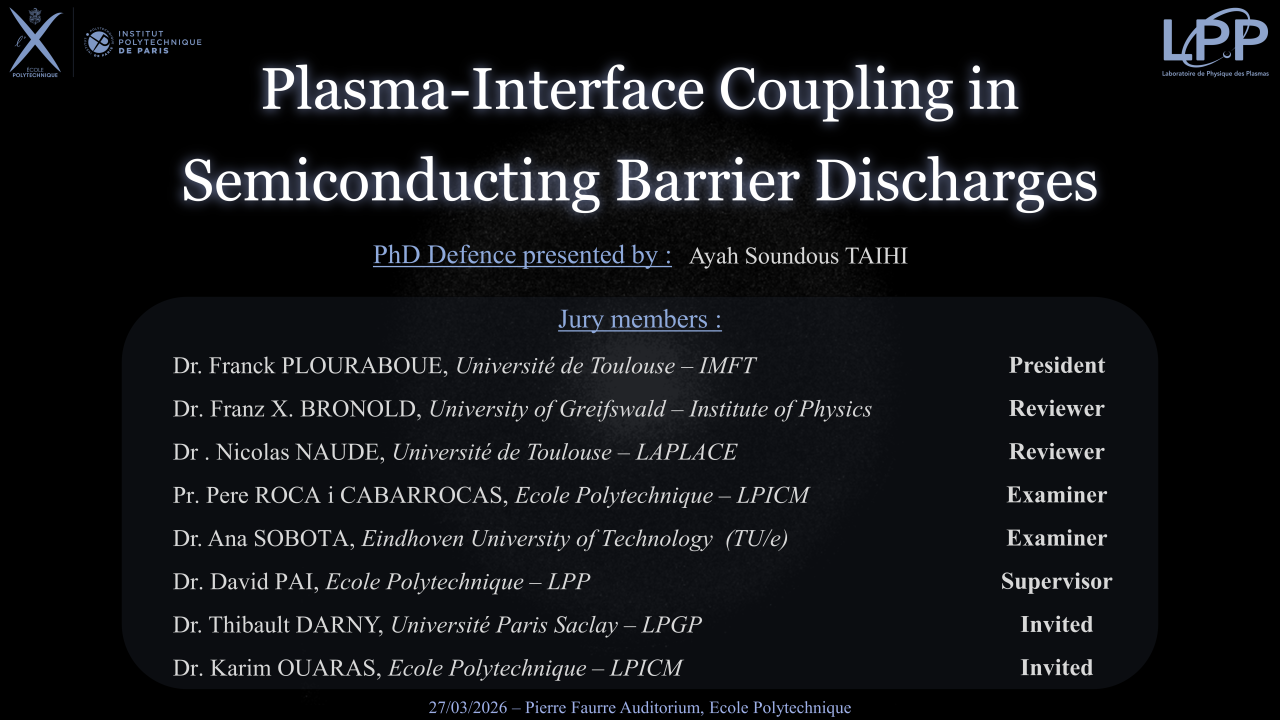
While Dielectric Barrier Discharges (DBDs) are widely used for atmospheric-pressure plasma generation, their performance is often constrained by filamentation and limited energy density. Recently, Semiconducting Barrier Discharges (SeBDs) have emerged as a promising alternative, offering uniform plasma generation and the potential for higher energy density.
To elucidate the underlying physical mechanisms, this work presents an experimental study of SeBDs generated using nanosecond pulses applied to Si-SiO2 substrates. Plasma behaviour was characterized through fast imaging, current-voltage measurements and optical emission spectroscopy. As a first phenomenological framework, the SeBD was compared to a Metal-Oxide-Semiconductor (MOS) capacitor operating in the strong inversion regime.
First, external irradiation of the interface enhances plasma emission and the electric field, with a stronger effect at shorter wavelengths. These wavelengths have a shorter penetration depth in silicon and are therefore mostly absorbed within the depletion region, enabling efficient carrier separation and impact ionization amplification. Additionally, intermediate silicon doping levels were identified as optimal for discharge extent, ensuring a balance between recombination, mobility, and interfacial electric field strength. In contrast, intrinsic silicon induces deformation of the SeBD, attributed to its insufficient charge-carrier density to effectively screen the electric field of surface charges. Finally, SeBD homogeneity and extent were found to depend on the pulse shape and voltage polarity, as these parameters govern depletion region formation as well as the resulting interfacial electric field strength.
In summary, this work establishes new insights into plasma-semiconductor coupling at atmospheric pressure, demonstrating the combined roles of photonic and interfacial electric field effects. These findings open new avenues for the design of plasma devices that exploit the synergy between semiconductor optoelectronic properties and discharge dynamics.
Location:
Ecole polytechnique – Pierre Faurre auditorium.
Jury composition:
Franck Plouraboue – Université de Toulouse, IMFT
Franz X. Bronold – University of Greifswald, Institute of Physics
Nicolas Naude – Université de Toulouse, LAPLACE
Pere Roca I Cabarrocas – Ecole polytechnique, LPICM
Ana Sobota – Eindhoven University of Technology, TU/e
David Pai – Ecole polytechnique, LPP
Thibault Darny – Université Paris Saclay, LPGP
Karim Ouaras – Ecole polytechnique, LPICM